
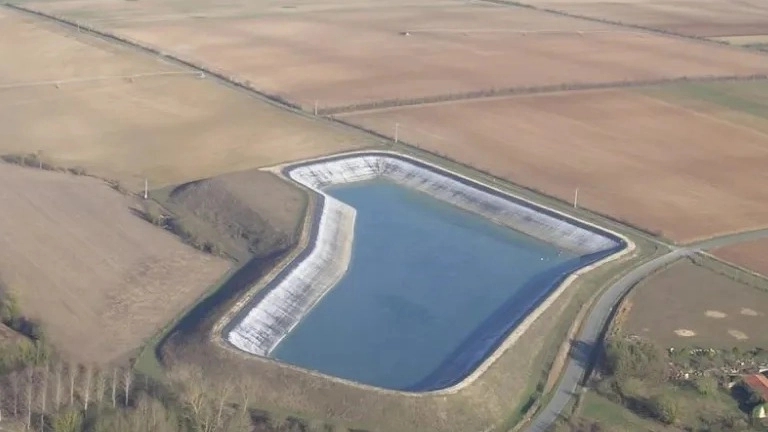
What is an agricultural pool?
Agricultural pool or water storage pool is a large pool on the ground, the construction of which is necessary to collect and store seasonal water, so that this stored water can be used in rainy and dry seasons for agriculture and animal husbandry. These pools have inlets to regulate the inflow and outflow to drain excess water. One of the important uses of agricultural ponds is irrigation of agricultural lands, gardens and livestock. These pools can be used to irrigate agricultural crops, create an environment for aquaculture or animal husbandry.
Water storage ponds can also be a convenient and sustainable source of water storage for cities and villages. Aquatic animals such as fish, oysters, aquatic plants or pool algae can be grown in these ponds. These pools can be used not only for the mentioned purposes, but also for recreational and beauty purposes in the yard, garden or farm. Construction of recreational lakes, fishing and boating are other uses of these types of pools.
☑️ Agricultural use of water storage pools
Agricultural water storage pools or geomembrane pools will be a serious crisis for farmers, depending on the amount of agriculture in the summer season and the amount of rainfall in other seasons and the lack of water resources. Considering the increasing demand for water resources and the existence of some shortages in this process, the importance of protecting and managing these resources is increasing day by day. Today, concrete, asphalt or bitumen materials are mostly used to store agricultural water or build geomembrane pools. Because the economic costs are lower and the life span is longer, and the performance cost of geomembranes is also lower. Geomembranes are resistant to sunlight and are much more resistant to hot and cold weather than concrete (pool concreting), so that geomembranes can withstand temperatures of +80°C and -70°C. grad will have resistance.
☑️ Types of agricultural pools
☑️ Concrete Pools:
Concrete pools are one of the types of traditional pools that are built by digging in the ground and then concreting the floor. In order to insulate them, various materials such as cement, concrete, etc. are used. The construction of pools is often very time-consuming and their maintenance and efficiency will not be much compared to other pools (such as natural pools and endless pools, etc.).
☑️ Geomembrane Pools:
These pools, after digging, are covered with a type of polymer coating called geomembrane sheet. The construction steps of this type of pool require the help of specialists and specialized raw materials, and this causes the construction costs to be relatively high despite the short time required for its construction.
☑️ Fiberglass pools:
These pools are completely made of fiberglass and do not require insulation and long-term preparations. They can be easily installed on site and have a longer lifespan than concrete and cement pools. However, it is often very difficult to transport them from the production site to the installation site due to their very large and integrated dimensions. In addition, due to this difficult transportation, there will be limitations in ordering the desired dimensions, and after installation, it will not be possible to completely renew it.
Other types of agricultural pools include brick pools with cement coating, pools made of integrated fiber sheets, stone and cement pools with isogam insulation, and prefabricated pools that include a metal body and a PVC layer (upvc pipe and upvc glue) inside. are, he pointed out.
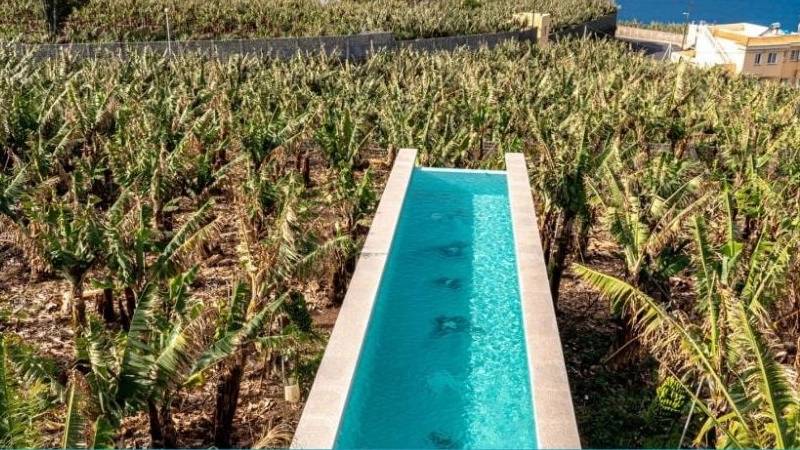
☑️ Steps to build the agricultural pool
Methods of insulating agricultural pool
Sealing with lime and clay:
Building a pool with this type of insulation will be very time-consuming and cannot provide a completely uniform surface against leaks. The soil on the bottom of the pool should be saturated when covering with lime so that it can hydrate the lime well and the liming operation can be carried out by maintaining the moisture of the lime. Also, water is not added immediately after the sealing operation is completed, and the lime should be given time to settle well. When adding water to the pool, it should be done slowly. Because turbulent currents can damage the sealing layers. In addition, the pool can never be kept completely dry. Because the drying of the pool causes linen cracks in the layers, which causes leakage from the body and floor of the pool. After cracking, the water holding capacity also decreases.
Bentonite sealing:
Because the bentonite particles are so small, when spread over the pool, they can be released into the air and inhaled into the lungs, so a mask must be used to prevent the particles from reaching the lungs. Also, this method should not be used in hot weather. Before insulation, all debris must be removed from the bottom of the pool and water must be carefully introduced into the pool so as not to disturb or destroy the bentonite. Also, the appropriate depth of compacted soil should be created. Proper soil compaction should be achieved by bringing the soil moisture to the desired moisture level.
Sealing of concrete pools:
Epoxy coatings, which are often used to insulate concrete pools, are very fragile. For this reason, if the concrete pool has small cracks, these cracks will break the epoxy coating at the place of the crack. Another disadvantage of these coatings is their high price compared to other sealing materials.
Standard dimensions of agricultural pool
In the construction of agricultural ponds, no specific and predetermined dimensions can be specified. Because everything will depend on the type of use, the amount of consumption, the amount of available water reserves, the area of the selected land, as well as the characteristics of the land and soil. Nevertheless, the proportion between the length, width and depth of the pool must be observed in any case. For example, paying attention to the standard slope, which is often 1.1 or 45 to 60 degrees of the pool walls, should be considered in every case. Also, depending on the type of soil, the depth of the pool may be different. Therefore, in order to determine the appropriate dimensions, the expert technical technician must determine the applicable and standard dimensions by examining the land, soil, resources and customer needs.